

The vagus nerve derives its name from the Latin word for “wanderer,” reflecting its extensive journey from the brain to the large intestine. As the longest cranial nerve, it extends throughout much of the body, influencing areas such as the throat, heart, lungs, stomach, liver, spleen, pancreas, kidneys, and both the large and small intestines.
Recent discoveries over the past two decades have greatly expanded our understanding of the vagus nerve. Research indicates that it transmits signals from the gut to the brain using neurotransmitters like serotonin and glutamate, along with gut hormones. These neurotransmitters are crucial for regulating sleep, mood, pain, stress, and hunger.
A key role of the vagus nerve is to convey fight, flight, or freeze signals from the brainstem, often referred to as the lizard brain (limbic system), enabling the body to prepare for a survival response. Additionally, this nerve can help relax the body after periods of stress and danger.
The vagus nerve regulates:
- Heart rate
- Breathing
- Blood pressure
- Digestion
- Mood
- Immune Function
No wonder, the vagus nerve plays such an important role in the well-being of our life. When you look at a diagram of the vagus nerve, you’ll see it connects to every major organ in the body, including:
- Taste buds and saliva glands
- Eye nerves
- Esophagus
- Stomach
- Pancreas
- Large and small intestines
- Lungs
- Heart
- Liver
- Gallbladder
- Adrenals
- Kidneys
- Spleen
- Bladder and reproductive organs
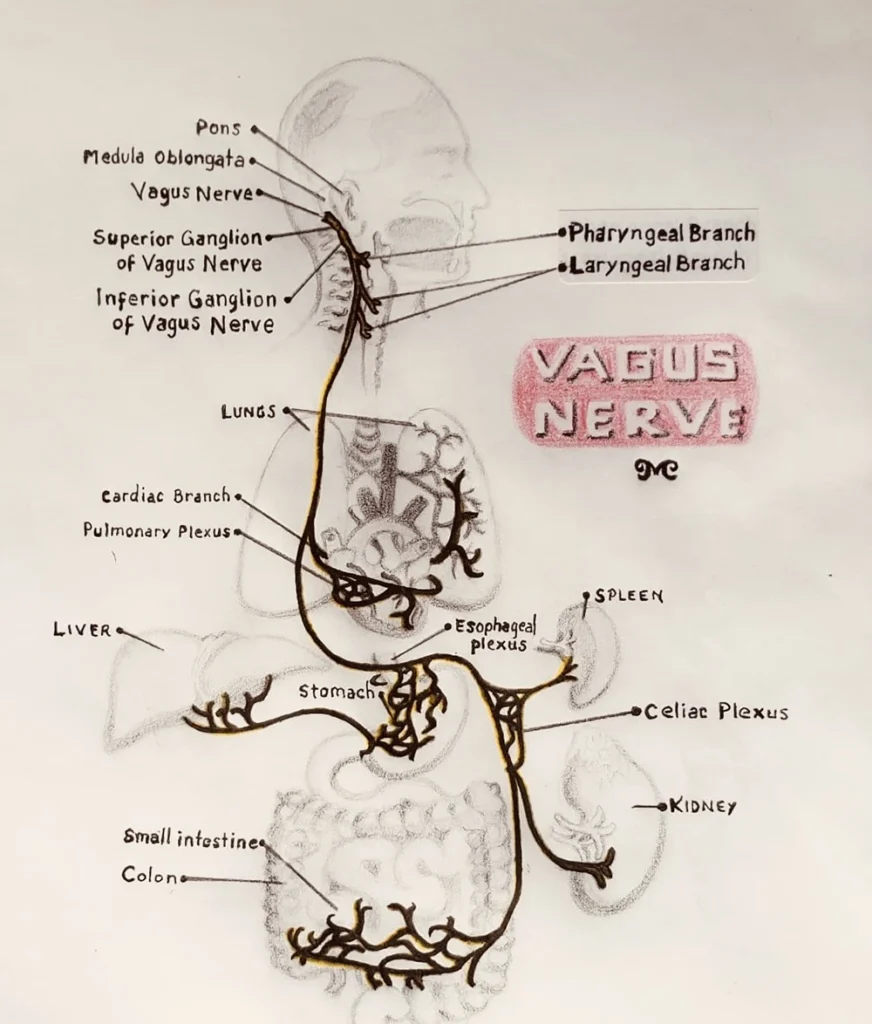
This nerve carries information and direction to and from these organs and contributes to managing inflammation in our bodies. It also initiates anti-inflammatory signals, effectively reducing damaging inflammation throughout the body. In short, a higher vagal tone means a healthier internal world and therefore, a healthier life.
The vagus nerve is what slows us down and brings balance to our nervous system. Although scientists are still unclear on how the vagus nerve impacts health and cognition, The Food and Drug Administration has approved devices that stimulate this nerve with electrical impulses for the treatment of specific conditions, including epilepsy, depression, migraine and cluster headaches.
EXPERTS’ COMMENTS ABOUT THE SIGNIFICANCE OF THE VAGUS NERVE IN HEALTH AND WELLNESS
- – Autonomic Nervous System Regulation:
The vagus nerve is a major component of the parasympathetic nervous system, which helps regulate heart rate, digestion, and respiratory rate. This regulation is vital for maintaining homeostasis (Porges, S.W. 2011. “The Polyvagal Theory”). - – Stress Reduction:
Stimulation of the vagus nerve can reduce stress and anxiety levels. Techniques like deep breathing and meditation can activate the vagus nerve, promoting a relaxation response (Kabat-Zin J. 1990. Full Catastrophe Living). - – Gut-Brain connection:
The vagus nerve facilitates communication between the gut and the brain, influencing digestive health and emotional well-being. This connection can impact mood and cognitive functions (Mayer, E.A. 2011). “Gut/Brain Connection). - – Inflammation Control:
The vagus nerve has been found to play a role in controlling inflammation through the inflammatory reflex. This can be significant in managing conditions such as rheumatoid arthritis and inflammatory bowel disease (Borovikova, L. et al. 2000. “Vagus Nerve Stimulation Attenuates the Systemic Inflammatory Response to Endotoxin”.). - – Heart Health:
Vagal tone is associated with cardiovascular health. Higher vagal tone can lead to better heart rate variability, which is a marker of heart health (Kemp, A.H. & Quintana, D.S. (2013) “The Importance of the Heart Variability”. - – Research indicates that vagus nerve stimulation can be beneficial for treating depression and other mood disorders, offering a potential therapeutic avenue for patients who do not respond to traditional treatments (Mayo Clinic, 2006. “Vagus Nerve Stimulation in Major Depressive Disorder”)

Impact on women’s libido
One of my main interests is Women’s health. For this reason, I currently do much research on what affects us as we begin to experience body changes, internal and external, and the practices that can support us in the process.
Women typically experience major body and hormonal changes starting with puberty (around ages 8-13), followed by significant shifts during their 20s/30s (reproductive years), and a major transition known as perimenopause and menopause in their 40s to early 50s.
It is in this major transition that women’s sexual energy begins to change. Libido in women varies widely but it is definitely influenced by hormones, physical health, stress, and relationship quality.
Now that we know a bit more about the importance of the vagus nerve, we can easily see that the connection of the vagus nerve to our brainstem is different from its being connected to our thinking brain. When it comes to women’s sexuality, there is only one language the brainstem speaks: Am I safe? Or am I unsafe? Hence the importance of being able to find people and safe environments where we can be ourselves and feel fully understood and supported. Our bodies respond to stimuli. The difference between men and women is often great when it comes to sexual desire.
Our bodies do not lie; they only respond to our environment. Renowned psychotherapist, Nilda Chiaraviglio, states that men’s sexual desire is more automatic, visual and constant, but “Women’s sexual desire needs context; it requires for women to feel respected and that your partner values you not just for your body, but for who you are as a person. When women have this safe environment and feel respected, something magical happens, there are changes in the brain and, therefore, the body. The body softens, it opens up, and there is genuine desire and sex comes easily. This is when women’s sex life begins to change from something that feels like a routine or an obligation to something vibrant and passionate”.
In other words, the vagus nerve plays a critical role in the autonomic nervous system, which affects physiological responses during sexual arousal. Activation of the vagus nerve can enhance relaxation and lower stress, potentially increasing sexual desire. (Porges, S.W. 2011. “The Polyvagal Theory”).
The vagus nerve can also have hormonal influence as it may also interact with hormonal systems that regulate sexual function, such as testosterone and oxytocin, both of which are important for sexual desire (Shapiro, D. 2005. “Hormonal Influences on Sexual Function”).
This leads us to the next subject: The importance of emotional intelligence and its relation to wellness.
According to Mental Health America, Emotional Intelligence (EI), is the ability to manage both your own emotions as well as understand the emotions of other people around you. This requires self-awareness, self-regulation, motivation, empathy, and social skills to manage stress, communicate effectively, and build strong relationships. We can cultivate EI by encouraging practices such as:
- Mindfulness: knowing what you are feeling and why
- Self-regulation: Pausing to think before acting impulsively
- Open conversation and empathy: understanding and validating others’ perspectives, even if you disagree
- Accountability: accepting responsibility for mistakes and apologizing sincerely
- Adaptability: maintaining flexibility and staying committed to goals and intentions.
In addition, eating nourishing foods, cultivating conscious movement, and addressing traumas and fears can help us understand ourselves better and enhance our feelings of wellness. By paying attention to all these factors, we began to emphasize the important of making informed, conscious choices rather than choices based on visceral reactions, which are based on fear, disgust, or immediate gratification.
Therefore, true health encompasses the quality and balance of our physical, spiritual, and emotional lives and the steps we take to pursue a fulfilling and enriching life experience, regardless of our age and physical challenges.
Cultivating mental sanity and self-awareness is not easy. It takes much courage, humility and discipline; it is perhaps the greatest and most humble work we will do with ourselves, but through willpower and commitment, we can live a life worth-living and create sustainable changes.

HOW DOES DEEP RELAXATION AFFECT THE VAGUS NERVE SYSTEM?
Research has shown that deep relaxation techniques, such as slow breathing, meditation, and progressive muscle relaxation, stimulate the vagus nerve immediately, shifting the nervous system from a “fight-or-flight” state to a “rest-and-digest” (parasympathetic) mode. This activation lowers heart rate and blood pressure, reduces stress hormones, increases vagal tone (making future relaxation easier), improves digestion and even controls the inflammation response. (Cedars Sinai Healthcare organization).
Deep relaxation does the following:
- Activates the Parasympathetic Nervous System: Deep relaxation serves as a “calm button,” signaling to the brain that the body is safe. This triggers the vagus nerve to lower heart rate and blood pressure.
- Lengthens the Exhale: Techniques that emphasize slow exhales (e.g. 1:2 ratio of inhaling to exhaling) are particularly effective at stimulating the vagus nerve, inducing physical and mental calm.
- Improves vagal tone: Regular practice of relaxation, breathing exercises, meditation and yoga, strengthens vagal tone (referring to the activity of the nerve). A higher vagal tone makes it easier for the body to return to a calm state after stress.
- Modulates the Fight-or Flight Response: Deep diaphragmatic breathing helps move the body out of a state of panic, anxiety, or “frozen” states of stress, into a relaxed state.
- Direct Physical Stimulation of the vagus nerve: neck massage, singing, humming, or over splashing cold water on the face.
Some Key Relaxation Practices for Vagus Nerve Stimulation:
Diaphragmatic breathing:
- Lay down in a comfortable place. Bring your hands to your belly. Inhale and let out a long exhale.
- Now focus on your belly and allow the belly to receive the breath. Focus on the rhythm of your belly as you inhale and exhale through your nostrils.
- Eventually, allow your exhales to become longer (4:8 ratio).
- With every exhale, let your body become heavy.
- Begin to focus on the sensation of your body. You may start with your feet and move on to your ankles, shins, calf muscles and so on, without rushing. Notice the sensations and pulsations in every part of your body. Take your time to notice and allow the sensations to expand.
- Visualize the earth holding you fully.
- With every inhale, visualize your body expanding and receiving a cleansing breath; with every exhale, your body surrenders to the earth.

Other relaxation techniques to stimulate the vagus nerve include:
Meditation, progressive muscle relaxation, vocalizations such as humming or chanting (stimulation of the muscles in the back of the throat) walking in nature, observing the subtleties of the earth, movement of water, the color and shape of flowers, the sound of the wind and birds, and so on, can bring us much peace and inner contentment.
Life brings us constant challenges. We realize that balance is in constant play with imbalance, but with tools and compassion, we can become more resilient and bounce back faster after a big challenge or traumatic event. Learning about our bodies, the power of the vagus nerve, and the importance of deep relaxation and surrender may keep us inspired, living life with more joy, lightness and clarity. As we learn, let’s make it fun and stay curious.